Split-Second Edge Inference
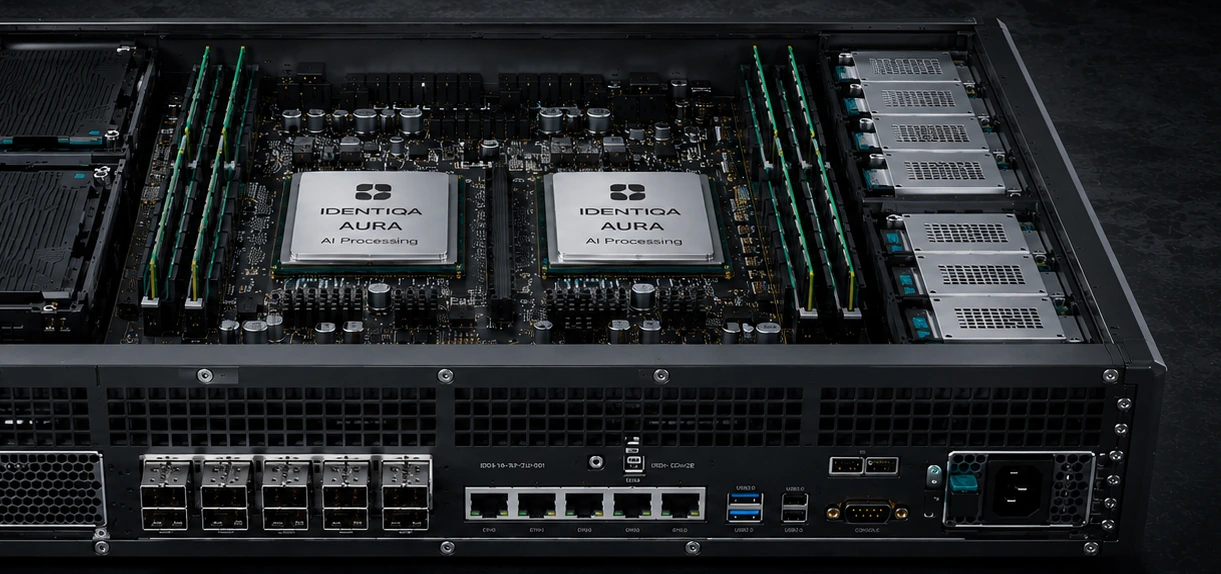
Local models running on dual Identiqa Aura processors inside AuraLink evaluate traffic and anomalies right in your rack.
Home / Aura
Aura, the multi-model defense AI by Identiqa.
Attackers use automated toolchains to probe your perimeter day and night. Manual ticket queues can't keep pace. Aura combines low-latency local models on the AuraLink appliance with frontier reasoning models and dark-web intelligence, while never receiving an open shell.
Aura orchestrates fast local models on dual Identiqa Aura processors in the rack and frontier reasoning models against Black Iris adversary intelligence, bounded by a closed set of signed actions.
Local models running on dual Identiqa Aura processors inside AuraLink evaluate traffic and anomalies right in your rack.
Complex attack chains are analyzed across multiple frontier reasoning models enriched with Black Iris dark-web and ransomware telemetry.
No model can invent a command or open a shell. Every action must match the closed command set in AuraCore or ProtectionGrid.
Verified intervention record
03:14:08.112Lateral SMB/RPC probe detected and correlated with Black Iris C2 fingerprint.
03:14:08.184Attack vector toward backup VLAN confirmed. Open shell blocked by architecture.
03:14:08.410Signed command ISOLATE_WORKLOAD verified and executed on node prd-db-eu-04.
03:14:08.690Snapshot snap-0314Z locked in storage. Signed audit record sent to SIEM.
Every AI decision is deterministically logged · Configurable for active signed defense or strict read-only SIEM/SOC output
ISOLATE_WORKLOAD + LOCK_SNAPSHOTOn-appliance (2× Aura processors) + 3 frontier modelsBlack Iris match: active ransomware staging infrastructure0 (Restricted to closed signed allowlist)ed25519:9a4f...e812 · VerifiedMulti-model + Black Iris · 0 shell
Aura is Identiqa's defense AI. It learns from every attack, tracks adversary infrastructure and leaked exposures into the dark web via Black Iris, and continuously probes your network for exploitable gaps. Unlike generic AI copilots, Aura operates inside strict architectural limits: no model ever receives an open shell, and every countermeasure is restricted to a signed command from a closed list.
A single language model loses context under pressure and can hallucinate a dangerous command. Aura is built as a multi-model orchestration layer: fast local models on the AuraLink appliance handle real-time decisions in the rack, while an ensemble of frontier reasoning models evaluates complex multi-stage intrusions.
Black Iris is Identiqa's forensic intelligence layer. It tracks adversary infrastructure, leaked credentials, and ransomware tactics across the dark web to give Aura immediate operational context before an attack reaches your perimeter.
Every action Aura proposes is validated against a closed command set in AuraCore or ProtectionGrid and executed only as a cryptographically signed command. Organizations that prefer zero automated changes run Aura in read-only mode to enrich their SIEM and alert their SOC.
We size Identiqa to your infrastructure and sites. Buy directly through Identiqa or on your existing agreement with Amazon Web Services, Google Cloud, or Microsoft Azure.
Architecture briefing & advisoryA dashboard copilot summarizes tickets for human analysts while automated scripts keep moving laterally. Aura, Identiqa's multi-model defense AI, is embedded directly into the 2U AuraLink appliance and AuraCore host manager to correlate live telemetry with dark-web adversary intelligence and execute or recommend cryptographically signed countermeasures.
By coupling forensic threat intelligence directly to edge and host controls. Identiqa's Black Iris engine continuously maps adversary infrastructure, exposed credentials, and ransomware operations into the dark web and feeds that context directly into Aura.
Through hard architectural guardrails with zero open shell access: in active mode, Identiqa Aura can trigger only cryptographically signed commands from the closed command set in AuraCore and ProtectionGrid. In read-only mode, Aura makes zero changes and instead writes structured findings to your SIEM and alerts your SOC.