The node is checked, not just the image
AuraCore continuously checks the hosts under your containers for authorized_keys, cron jobs, systemd units, sudoers rules, setuid binaries, and open sockets.
Home / AuraCore / Kubernetes Security
Kubernetes security and container security at runtime, with AuraCore on Linux and FreeBSD.
The image scan checks what you ship. It doesn't see what happens on the node three weeks later. AuraCore checks your nodes, Docker hosts, and servers in production for backdoors and acts only through signed commands.
Kubernetes security doesn't end at the image. An attacker who gets into a pod through a vulnerable application looks for the way down to the node and digs in there: in SSH keys, cron jobs, and systemd units. AuraCore by Identiqa checks these host-level persistence points continuously on Linux, FreeBSD, virtual machines, Kubernetes, and Docker.
Four layers on which a cluster can be attacked. Most teams check the top one. The three below it, rarely.
Known vulnerabilities in packages, checked before rollout.
Traces an attacker leaves in the running container.
authorized_keys, cron jobs, systemd units, sudoers, setuid binaries, and open sockets.
Each node is verified at startup through Secure Boot and TPM 2.0 attestation. AuraCore then talks to it only over mTLS.
Once an attacker gets into a container, the host is the next target. Access there survives every new deployment.
Without runtime checks
The new image is clean. The node underneath still belongs to the attacker.
With AuraCore
The backdoor doesn't go unnoticed, and the node is off the network.
Illustrative, simplified.
Many agents on servers open a root-level remote command channel. If the vendor's management plane is taken over, that channel is open to the attacker on every system at once. AuraCore has no open shell. It runs only signed commands from a closed command list.
AuraCore ties your existing systems into a verified network and shows what runs there.
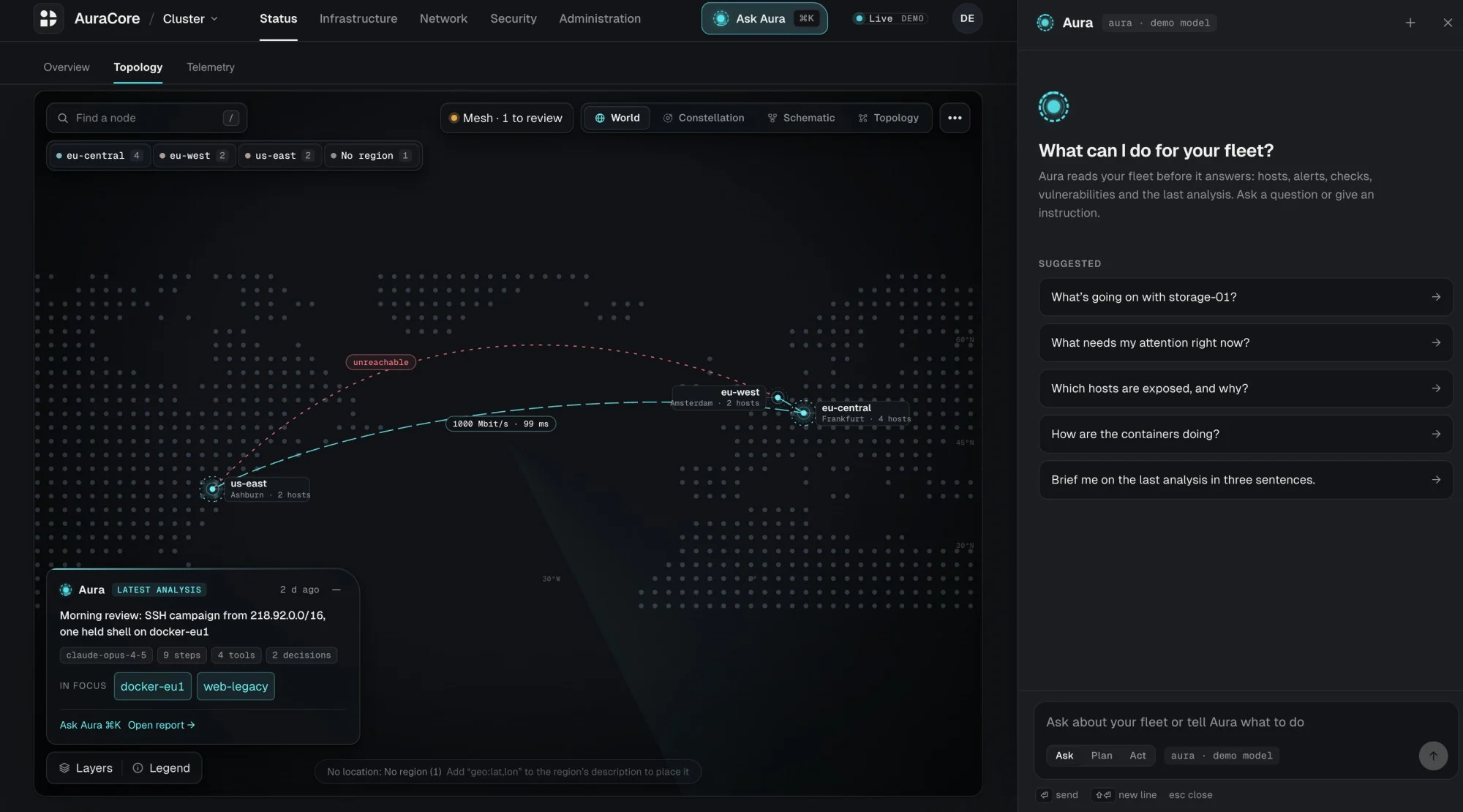
AuraCore maps your sites and the links between them. On the right, Aura answers questions about your fleet.
AuraCore continuously checks the hosts under your containers for authorized_keys, cron jobs, systemd units, sudoers rules, setuid binaries, and open sockets.
When AuraCore detects a backdoor or a critical vulnerability, it isolates the system or, after a dry run, applies a signed update.
AuraCore runs on the systems you already operate. It needs no new servers and no rebuild.
AuraLink keeps the backups of your databases and stateful data locked in your own rack, so you can recover cleanly after an incident.
No, it complements it. The image scan checks before rollout whether an image contains known vulnerabilities. AuraCore checks afterward, in production, whether someone has planted a backdoor on nodes, on hosts, or in containers.
No. AuraCore runs on the systems you already operate: Linux, FreeBSD, virtual machines, Kubernetes, and Docker.
It isolates the affected system or, after a dry run, applies a signed security update. If you want to observe first, run AuraCore in read-only mode: it then reports to your SIEM and informs your SOC without acting itself.
We size Identiqa to your infrastructure and sites. Buy directly through Identiqa or on your existing agreement with Amazon Web Services, Google Cloud, or Microsoft Azure.
Architecture briefing & advisory